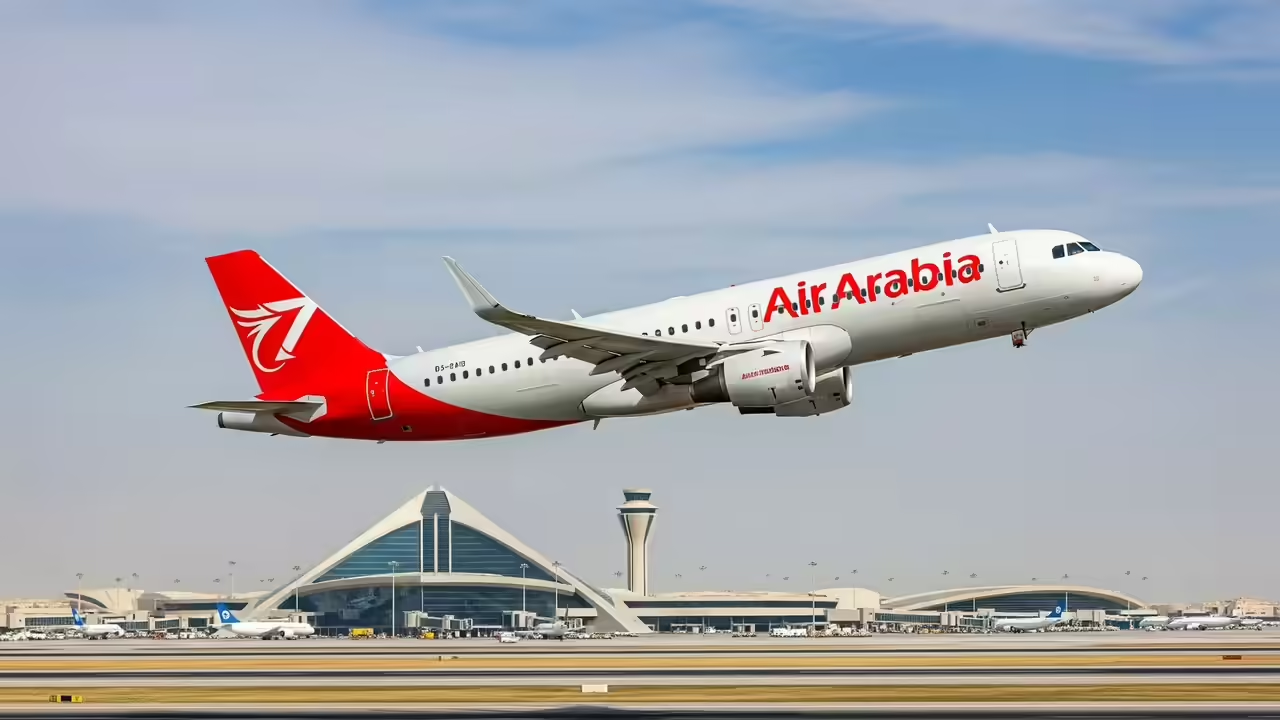
The Gulf aviation story is usually associated with enormous international airlines.
Large aircraft connect major hubs with almost every continent.
Premium cabins and long-haul networks receive global attention.
Air Arabia built a completely different business.
Instead of competing directly through luxury or intercontinental scale, the Sharjah-based airline focused on something much simpler: making air travel affordable.
When it launched in 2003, the low-cost carrier model was still relatively new in the Middle East.
More than two decades later, Air Arabia has grown into the largest low-cost carrier group in the Middle East and North Africa.
Its network now stretches across the Middle East, Asia, Europe and Africa from multiple operating hubs.
The company demonstrates how a very different aviation strategy can become highly successful in a region dominated by full-service giants.
Sharjah Was an Unusual but Strategic Starting Point
Air Arabia began operations from Sharjah International Airport.
The location provided several advantages.
Sharjah sits close to Dubai while operating a smaller airport with a different cost structure.
The airport is also accessible to residents of Ajman and the Northern Emirates.
Air Arabia could therefore serve a large population without competing directly for the same airport infrastructure used by Dubai’s major international carriers.
This helped support the low-cost model.
Lower operating complexity can translate into lower fares.
The Five-Hour Flying Radius Is Enormously Valuable
Sharjah sits within relatively short flying distance of some of the world’s largest population centres.
India is nearby.
Pakistan is nearby.
Central Asia is accessible.
The Middle East and North Africa are naturally connected.
Many European destinations can also be reached with narrow-body aircraft.
This geography allows Air Arabia to use Airbus A320-family aircraft across an enormous addressable market.
Narrow-body aircraft are central to low-cost airline economics.
They are cheaper to operate than wide-body long-haul aircraft on shorter routes.
The Low-Cost Model Depends on Simplicity
Budget airlines succeed by controlling complexity.
Air Arabia operates mainly Airbus A320 and A321-family aircraft.
Using a relatively standardised fleet reduces training and maintenance costs.
Pilots can operate aircraft from the same family.
Spare parts become easier to manage.
Maintenance teams need expertise across fewer aircraft types.
Aircraft can also be moved between routes more easily.
This simplicity is one of the core economic advantages of the low-cost model.
High Aircraft Utilisation Matters
An aircraft only earns revenue when it is flying.
Every hour spent unnecessarily on the ground creates cost without ticket revenue.
Low-cost airlines therefore focus heavily on fast turnarounds and high utilisation.
A plane lands, passengers leave, cleaning and servicing take place quickly, new passengers board and the aircraft departs again.
Repeating this process efficiently allows the same aircraft to operate more flights each day.
At fleet scale, even small improvements in turnaround time can significantly influence profitability.
Air Arabia Made Flying Accessible to a Larger Market
One of the most important effects of low-cost aviation is market creation.
Lower fares do not simply take customers from other airlines.
They allow people to travel who may otherwise not have flown at all.
This is particularly relevant in the Gulf.
Millions of expatriates live in the UAE and travel regularly to visit family abroad.
Price can be extremely important.
Affordable flights to South Asia, Egypt, Jordan and other regional markets therefore serve genuine social as well as commercial demand.
Visiting Friends and Relatives Is a Powerful Market
Airlines sometimes focus heavily on tourism and business travel.
The visiting-friends-and-relatives segment can be equally important.
A worker living in the UAE may travel home several times per year.
Family members may visit the Emirates.
These journeys occur repeatedly and are often highly price-sensitive.
Air Arabia’s network is well positioned for this demand.
Routes to India, Pakistan, Bangladesh, Egypt and other countries connect large expatriate communities with home markets.
Tourism Adds Another Growth Engine
Low fares can also stimulate tourism.
A weekend trip becomes more attractive when air tickets are affordable.
Destinations that might not justify an expensive full-service fare become accessible.
Air Arabia connects the UAE with cities across Central Asia, the Caucasus, Europe and North Africa.
This expands travel options beyond traditional major capitals.
Budget airlines often help secondary cities develop tourism by providing direct connections that did not previously exist.
The Network Has Expanded Far Beyond Sharjah
Air Arabia now operates through six main hubs.
These include Sharjah, Ras Al Khaimah and Abu Dhabi in the UAE, along with Casablanca in Morocco, Alexandria in Egypt and Karachi in Pakistan.
This multi-hub strategy is important.
The company no longer depends entirely on passengers originating in Sharjah.
Each hub can serve its own regional market.
The model can therefore be replicated across several geographies.
Morocco Created an Important European Platform
Air Arabia Maroc provides access to a different type of network.
Morocco has strong travel demand to Europe because of tourism, migration and business connections.
Casablanca offers flights into numerous European markets.
This gives the group exposure to traffic patterns quite different from those in the Gulf.
Geographic diversification reduces dependence on one region while making the overall brand more international.
Egypt Adds Another Large Population Market
Air Arabia Egypt provides a base in one of the Arab world’s largest countries.
Egypt has a population exceeding 100 million and significant outbound labour and tourism demand.
Alexandria offers another operating platform separate from Cairo’s main aviation hub.
The joint-venture model allows Air Arabia to participate in local markets through locally based airlines rather than simply flying there from Sharjah.
Air Arabia Abu Dhabi Expanded the UAE Strategy
Air Arabia Abu Dhabi was established as a joint venture with Etihad Airways.
This gave the group another important UAE hub.
The strategy is interesting because Abu Dhabi already has a major full-service airline.
The low-cost operation serves a different segment.
Travellers can choose according to price, destination and service needs.
This illustrates how budget and premium airlines can coexist within the same aviation ecosystem.
Ras Al Khaimah Provides Another Type of Opportunity
The Ras Al Khaimah hub supports the tourism ambitions of the Northern Emirates.
RAK has been investing heavily in resorts, leisure developments and international tourism.
Direct low-cost flights can help bring visitors without requiring them to travel through Dubai.
Air connectivity is one of the most important ingredients in destination development.
Hotels and attractions become easier to sell internationally when tourists can fly directly.
Karachi Marks Another Stage of International Expansion
Air Arabia’s Pakistan hub adds another significant market.
Pakistan has a large population and deep connections with the Gulf.
Millions of Pakistanis work across Middle Eastern economies.
Direct low-cost routes can serve both migrant and leisure traffic.
The Karachi hub demonstrates how the group is increasingly exporting its operating model rather than simply expanding routes from the UAE.
More Than 200 Routes Create Network Scale
Air Arabia now promotes a network of more than 200 routes across its hubs.
Scale creates several advantages.
The brand becomes more recognisable.
Aircraft can potentially be allocated between different markets.
Procurement can be centralised.
Technology investments can be shared.
A larger network also provides passengers with more reasons to remain familiar with the airline.
The Fleet Reached Around 90 Aircraft in Early 2026
During the first quarter of 2026, Air Arabia operated around 90 owned and leased Airbus A320 and A321 aircraft.
That is a major fleet for a low-cost carrier originating from Sharjah.
Additional aircraft are scheduled through an existing Airbus order book.
Fleet expansion creates route opportunities.
But aircraft must be deployed carefully.
Every new plane adds lease or ownership costs, pilots, maintenance and operational complexity.
Growth only creates value when enough profitable demand exists.
The A321 Changes What a Low-Cost Carrier Can Reach
The Airbus A321 family provides greater capacity and range than smaller A320 variants.
This allows Air Arabia to serve longer routes while retaining narrow-body economics.
Newer long-range variants can potentially push low-cost operations into markets previously requiring larger aircraft.
This is part of a broader aviation trend.
Modern narrow-body planes can fly farther than previous generations.
That opens new direct routes between cities that may not generate enough demand for wide-body aircraft.
Ancillary Revenue Is Central to Low-Cost Economics
A low headline fare does not mean every passenger pays only that price.
Budget airlines generate additional revenue through baggage, seat selection, meals and other optional services.
This approach allows customers to choose what they value.
Someone travelling light can pay less.
Another passenger can purchase additional comfort or baggage.
For the airline, these optional services increase revenue without raising the base fare for everyone.
Cost Discipline Is More Important Than Premium Service
Full-service airlines compete heavily through lounges, premium cabins and complex connecting networks.
Air Arabia’s competitive advantage comes from operating efficiently.
Aircraft need to be productive.
Distribution needs to remain cost-effective.
The fleet needs to stay relatively simple.
Airports and routes need to support quick operations.
This discipline is difficult.
A low-cost airline that allows expenses to rise cannot simply increase ticket prices without weakening its main advantage.
Fuel Is One of the Biggest Risks
Aircraft consume large quantities of jet fuel.
When oil prices rise sharply, airline costs can increase quickly.
Low-cost carriers are particularly sensitive because fares are highly competitive.
Air Arabia uses fuel hedging to reduce some exposure to price movements.
Hedging cannot eliminate risk completely, but it can provide greater cost visibility.
The challenge is predicting future fuel requirements and market conditions accurately enough for hedging to remain beneficial.
Regional Conflict Hit H1 2026 Hard
The first half of 2026 demonstrated how exposed aviation is to geopolitics.
Regional conflict caused airspace closures and operational restrictions.
Air Arabia had to reduce capacity.
Passenger numbers declined.
Fuel prices also rose sharply.
The company carried more than 8.7 million passengers during the six-month period, down 14 percent year-on-year.
These conditions were largely outside management’s control.
The Airline Still Remained Profitable
Despite severe disruption, Air Arabia reported H1 2026 net profit of AED 374 million.
Revenue declined only 1 percent to AED 3.48 billion.
The average seat load factor remained 83 percent.
Remaining profitable during significant airspace restrictions demonstrates the resilience of the low-cost model.
The company could adjust capacity rather than continuing to operate uneconomic flights.
High load factors also showed that demand remained strong on routes that continued operating.
Load Factor Is One of Aviation’s Most Important Metrics
A plane departing with empty seats loses revenue that can never be recovered.
Once the aircraft leaves the gate, that empty seat has no future value.
Load factor therefore measures how effectively airlines fill their capacity.
Air Arabia maintained an 83 percent average load factor during H1 2026 despite disruptions.
That indicates customers continued purchasing available seats even as the network was reduced.
Low-Cost Carriers Can Be More Flexible During Disruption
A simpler fleet provides operational flexibility.
If several routes become unavailable, aircraft of similar type can potentially be redeployed elsewhere.
Full-service airlines operating many aircraft categories may have more restrictions.
This does not make Air Arabia immune to geopolitical disruption.
But standardisation can make network adjustment easier.
Flexibility becomes especially valuable in regions where airspace conditions can change rapidly.
Sharjah International Airport Grows Alongside the Airline
Air Arabia’s growth and Sharjah Airport are closely connected.
The airline brings millions of passengers through the airport.
Airport expansion creates additional capacity for the airline.
This relationship benefits the wider Emirate.
Passengers support transport, hotels, restaurants and tourism businesses.
A successful home carrier effectively becomes part of local economic infrastructure.
The Business Is Also Important to Sharjah’s Global Identity
Dubai and Abu Dhabi dominate much international discussion of UAE aviation.
Air Arabia gives Sharjah its own globally recognised airline brand.
That creates visibility for the Emirate.
The airline’s aircraft carry Sharjah’s name to destinations across Europe, Asia and Africa.
For a smaller Emirate competing for international tourism and investment, that visibility has real value.
Digital Distribution Supports the Low-Cost Model
Customers increasingly book directly through airline websites and applications.
Direct digital sales can reduce dependence on travel agents and third-party platforms.
This lowers distribution costs.
It also gives airlines direct customer data.
Air Arabia can use this information to improve offers and sell additional services.
Technology therefore contributes directly to the economics of low-cost aviation.
AI Could Improve Revenue Management
Airline pricing is one of the most complex applications of data analytics.
The price of the same seat can change according to demand, booking timing and route conditions.
AI can potentially improve these systems.
Algorithms can analyse historical booking patterns, events and competitor pricing.
Better demand forecasting can help airlines decide how much to charge and where to deploy aircraft.
Small improvements in revenue per seat can create significant value across millions of passengers.
Sustainability Is a Growing Challenge for Aviation
Aviation is difficult to decarbonise.
Batteries remain too heavy for most commercial aircraft applications.
Sustainable aviation fuel is available only in limited quantities and often costs more.
Newer aircraft improve efficiency, but they still use fossil-based fuel.
Air Arabia’s fleet modernisation can reduce fuel consumption per passenger.
However, aviation will remain under pressure to reduce emissions as global climate policies become stricter.
Low-Cost Airlines Have an Efficiency Advantage Per Passenger
High seat density and strong load factors can reduce emissions per passenger compared with operating a similar aircraft with fewer occupied seats.
This does not eliminate aviation emissions.
But efficiency matters.
An aircraft flying nearly full spreads fuel consumption across more passengers.
For Air Arabia, the same operating discipline that lowers costs can also improve emissions intensity.
Why Air Arabia Matters
Air Arabia changed the aviation market by proving that the Gulf could support a large homegrown low-cost airline.
It started from Sharjah with a simple model.
Today, it operates from six hubs and serves more than 200 routes.
Its fleet has grown to around 90 aircraft with more on order.
Most importantly, it has made international travel accessible to millions of passengers who care more about price and convenience than premium lounges.
The difficult first half of 2026 demonstrated both the vulnerability and resilience of aviation.
Airspace disruption reduced capacity sharply.
Yet Air Arabia still produced AED 374 million in profit and maintained an 83 percent load factor.
That ability to stay profitable while operating through major disruption says a great deal about the strength of the model Sharjah began building more than two decades ago.
Contributed by GuestPosts.biz.