Salik is built around an unusually simple idea.
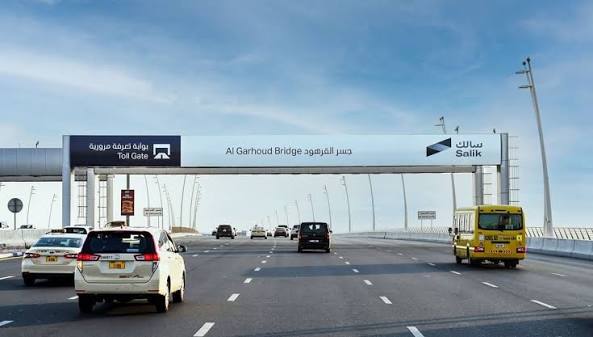
Vehicles drive beneath toll gates.
A fee is deducted automatically.
Millions of these small transactions accumulate.
The result is one of Dubai’s most profitable infrastructure businesses.
Salik does not manufacture products.
It does not operate thousands of shops.
It does not need a large workforce relative to its revenue.
Its physical infrastructure is limited compared with many utilities.
Yet the company sits directly inside one of Dubai’s most essential systems: road mobility.
That combination has created a business capable of producing extraordinary margins.
Salik Is Dubai’s Exclusive Toll-Gate Operator
Salik operates Dubai’s electronic road-toll system.
Vehicles pass under toll gates without stopping.
Automatic identification technology recognises the vehicle and deducts the applicable amount from the user’s account.
The system avoids physical toll booths.
This keeps traffic moving and reduces the need for large roadside tolling infrastructure.
For a city built around high vehicle mobility, that efficiency matters.
Drivers experience Salik primarily as a small charge.
At the scale of hundreds of millions of journeys, those charges become substantial revenue.
The Network Now Contains Ten Gates
Dubai’s toll system expanded from eight to ten gates in November 2024.
The newer gates increased Salik’s coverage across important road corridors.
The company operates under a long-term concession arrangement with Dubai’s Roads and Transport Authority.
This gives Salik a highly unusual competitive position.
Another toll operator cannot simply open a competing gate nearby.
The exclusivity of the concession creates a strong economic moat.
Road Traffic Is Closely Connected to Dubai’s Growth
Salik’s revenue depends heavily on traffic.
More residents create more journeys.
Tourists hire taxis and rental cars.
Businesses generate commercial travel.
New communities increase commuting distances.
This means Dubai’s population and economic growth feed directly into Salik’s business.
In 2025, the network recorded 852.7 million total trips.
Of those, 639.1 million were chargeable.
These enormous volumes illustrate just how deeply the toll system is embedded into everyday movement around the city.
The Economics Are Remarkably Attractive
Infrastructure businesses often require enormous ongoing capital expenditure.
Airports need terminals.
Utilities maintain power plants and networks.
Rail systems require trains and track.
Salik’s capital requirements are comparatively small.
The core tolling infrastructure already exists.
Vehicles carry their own identification tags.
Transactions are largely digital.
This contributes to exceptionally high cash generation.
Salik’s EBITDA margins have remained around 70 percent.
Very few large public companies operate at this level of profitability.
Variable Pricing Changed the System
Dubai introduced variable Salik pricing in 2025.
This represented an important evolution from a simple fixed toll.
Prices can now differ according to time and traffic conditions.
The objective extends beyond revenue.
Road pricing can influence behaviour.
If peak-hour travel becomes more expensive, some drivers may change departure times or routes.
Even a relatively small shift can reduce congestion during the busiest periods.
This makes Salik part of Dubai’s traffic-management strategy rather than merely a fee-collection mechanism.
Congestion Has an Economic Cost
Traffic delays are not just frustrating.
They reduce productivity.
Employees spend time in vehicles instead of working or with families.
Delivery companies complete fewer jobs.
Fuel and energy are wasted.
Roads need expansion.
Cities around the world therefore experiment with congestion charging and dynamic road pricing.
Dubai’s electronic tolling infrastructure gives it the ability to manage this problem without installing conventional toll plazas.
Dubai’s Population Growth Provides a Long-Term Tailwind
Dubai continues attracting residents.
Every additional resident does not automatically become a Salik customer, but population growth generally increases travel demand.
New suburbs can also lengthen commuting distances.
A professional living in one part of Dubai and working in another may pass several gates every day.
This makes urban expansion directly relevant to Salik’s economics.
By the first half of 2026, active registered accounts had reached approximately 2.9 million.
Registered Vehicles Continue to Increase
The system had around 4.76 million registered vehicles at the end of 2025.
This base includes residents as well as vehicles passing through Dubai from other Emirates.
The UAE is highly interconnected.
Thousands of people commute between Dubai and Sharjah or Abu Dhabi.
Salik therefore captures traffic generated beyond Dubai’s official population.
This broadens the effective market.
The First Half of 2026 Demonstrated Traffic Sensitivity
Salik’s H1 2026 results also showed that the business is not completely immune to external events.
Regional disruption affected mobility during part of the period.
Total trips fell compared with the previous year.
Revenue declined 7.5 percent to AED 1.412 billion.
Net profit decreased to AED 704 million.
These results reveal the most important variable in Salik’s model.
When people travel less, revenue responds.
The company may have a highly profitable concession, but it still depends on traffic volume.
Margins Remained Exceptionally Strong
Despite weaker traffic, Salik generated EBITDA of AED 975.6 million in the first six months of 2026.
Its EBITDA margin was 69.1 percent.
Net profit margin remained approximately 49.9 percent.
This demonstrates the resilience of the cost structure.
Revenue declined, but the business remained extremely profitable.
A large portion of each additional dirham of toll revenue can eventually translate into cash flow because operating expenses are relatively low.
Traffic Had Begun Recovering
Management reported that traffic flows were beginning to recover after the disruption earlier in 2026.
This matters because Salik’s core growth story remains closely linked to Dubai’s structural expansion.
Short-term events can reduce journeys.
Long-term population and economic growth can push them higher again.
Investors therefore need to separate temporary traffic shocks from lasting changes in mobility behaviour.
Public Transport Is Both a Competitor and a Complement
Dubai continues expanding the Metro, bus networks and other public transportation.
At first glance, this may appear negative for a toll operator.
Every commuter switching from a car to Metro potentially removes toll journeys.
The relationship is more complex.
Dubai’s population can grow fast enough for both public transport and road traffic to expand.
Better multimodal transportation can also reduce congestion, making roads more efficient for drivers who still need them.
Salik therefore operates within a much larger mobility ecosystem.
Remote Work Can Influence Toll Volumes
Another structural factor is changing work behaviour.
Hybrid work can reduce the number of weekly commutes for some employees.
A worker travelling to the office three days rather than five may pass toll gates less frequently.
However, flexible work can also spread traffic more evenly throughout the day.
The long-term effect will depend on how employment patterns evolve.
For Salik, understanding travel behaviour becomes increasingly important.
Tourism Supports Traffic Too
Dubai welcomed enormous numbers of visitors each year.
Tourists use taxis, chauffeured vehicles and rental cars.
Many of these journeys pass Salik gates.
Tourism therefore contributes indirectly to toll revenue.
Large exhibitions, sporting events and holiday periods can influence road activity significantly.
The toll business benefits from the same global attractiveness that supports hotels, airlines and retail.
Taxis Create a Different Relationship
Taxi journeys represent an important part of Dubai road usage.
Some toll arrangements treat taxis differently depending on specific rules and circumstances.
More broadly, the rapid expansion of ride-hailing and app-based transport means vehicles may travel much greater distances each day than ordinary private cars.
This concentrates a large number of trips into commercial mobility fleets.
The evolution of autonomous taxis could eventually make this segment even more important.
Autonomous Vehicles Could Increase Road Utilisation
Self-driving vehicles create an interesting future scenario for Salik.
Autonomous taxis may operate for more hours each day than human-driven vehicles.
A vehicle could finish one passenger trip and immediately travel to another customer.
This could increase total vehicle kilometres even without proportional population growth.
Alternatively, shared autonomous mobility could reduce private car ownership.
The final effect is uncertain.
What is clear is that future transport technology can materially change toll traffic.
Salik Has Ambitions Beyond Tolling
The company has stated that it wants to become a broader provider of smart and sustainable mobility solutions.
This is strategically logical.
A tolling concession is enormously valuable, but long-term growth becomes stronger if additional revenue streams can be built around it.
The company already interacts digitally with millions of drivers.
That customer relationship may support adjacent mobility services.
The challenge is entering new areas without distracting from an exceptionally profitable core business.
Parking Has Become a Natural Adjacent Opportunity
Salik has explored partnerships around parking-payment solutions.
Tolling and parking share several characteristics.
Both involve charging vehicles for access to scarce transportation infrastructure.
Both can be automated digitally.
Both benefit from vehicle-recognition technology.
A Salik account that works across tolls and parking could make the user experience more convenient.
For the company, it creates another transaction stream.
Ancillary Revenue Is Growing From a Small Base
Salik has been increasing revenue outside standard toll usage.
The numbers remain modest relative to tolling, but diversification is strategically important.
Additional services can increase revenue per registered user without constructing new toll gates.
This may eventually include parking, advertising or other mobility-related products.
Digital infrastructure allows experimentation at relatively low incremental cost.
The Company Owns Valuable Mobility Data
Hundreds of millions of annual trips create an enormous dataset.
Salik can observe traffic volumes across important road corridors and time periods.
Used appropriately and within privacy requirements, this information can support transport planning.
It can help identify congestion patterns and understand how road pricing affects behaviour.
Data may ultimately become one of the company’s most valuable strategic assets.
AI Could Improve Traffic Analysis
Artificial intelligence can analyse mobility data at a scale impossible for human analysts.
Algorithms could identify patterns across time, weather, holidays and events.
This may improve forecasts.
It can also help city planners test potential toll-pricing scenarios.
For Salik, AI is unlikely to replace the core business.
It can make the tolling infrastructure more intelligent.
New Toll Gates Can Create Immediate Revenue Growth
Salik’s 2024 expansion demonstrated the economic impact of adding gates.
The introduction of two additional locations increased the network from eight to ten.
Because millions of vehicles already use the Salik system, new gates can begin generating revenue without requiring customers to adopt an entirely new payment method.
This makes network expansion particularly powerful.
However, new gates are determined through coordination with Dubai’s transport authorities rather than Salik simply installing them wherever it chooses.
The Concession Is the Company’s Most Valuable Asset
Salik operates through a concession arrangement with RTA.
The concession runs for decades.
This gives the company long-term visibility.
Investors can estimate traffic growth, toll rates and operating expenses across a very long horizon.
Few listed businesses have such predictable structural rights.
The flip side is concentration.
Salik depends heavily on one city and one regulatory framework.
Its extraordinary competitive advantage is therefore also its greatest concentration risk.
The IPO Turned Road Infrastructure Into an Investable Business
Salik listed on the Dubai Financial Market in 2022.
The transaction formed part of Dubai’s programme to list major government-related businesses.
The IPO allowed private investors to participate directly in an infrastructure asset that had previously sat within the public sector.
For Dubai, listings such as Salik deepen the local stock market.
They also create a market valuation for important city infrastructure.
The Dividend Model Is Particularly Attractive to Income Investors
Salik has distributed a large proportion of its profit to shareholders.
This is possible partly because the business has relatively limited capital requirements.
Many growth companies must reinvest almost all their earnings.
Salik can generate strong cash flow without building factories or purchasing large amounts of inventory.
This creates capacity for substantial dividends.
For income-focused investors, that can make the company particularly attractive.
Low Capital Intensity Is a Major Competitive Advantage
Salik reported capital expenditure equal to only around 0.1 percent of revenue in 2025.
That is extraordinarily low.
Once the tolling infrastructure is operating, ongoing physical investment is limited relative to revenue.
This means a high proportion of operating cash can potentially become free cash flow.
The business resembles a digital payments platform layered onto physical roads more than a conventional transport infrastructure operator.
What Happens as Electric Vehicles Grow?
Unlike fuel retailers, Salik is largely indifferent to what powers a vehicle.
A petrol car passing through a gate pays.
An EV pays.
A future autonomous car can pay.
This gives the company an unusual form of protection against the energy transition.
Mobility technology can change dramatically without destroying the underlying tolling model.
As long as vehicles continue using Dubai’s roads, the infrastructure remains relevant.
Why Salik Matters
Salik demonstrates how a simple public-service function can become a highly efficient listed business.
Ten toll gates generate hundreds of millions of annual vehicle movements.
Automated billing keeps operating costs low.
A long-term concession creates a powerful competitive position.
Dynamic pricing allows tolling to become a traffic-management tool.
And a growing digital customer base creates opportunities beyond the toll gate itself.
The company’s H1 2026 results also showed the limits of the model.
When traffic falls, revenue falls.
But even during a difficult period, Salik maintained an EBITDA margin close to 70 percent.
Few infrastructure businesses combine that level of profitability with such limited capital requirements.
Dubai’s roads may look like ordinary public infrastructure.
For Salik, they form the foundation of an unusually powerful business model.
Contributed by GuestPosts.biz.