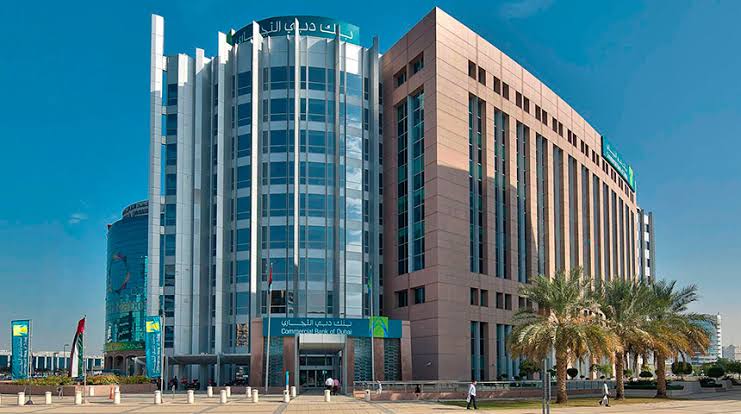
The UAE banking market contains several names recognised across the entire region.
Commercial Bank of Dubai has often taken a quieter approach.
Yet the institution established in 1969 now manages more than AED 150 billion in assets and has passed an important threshold: more than AED 100 billion in net customer loans.
This scale places CBD firmly among the country’s major financial institutions.
Its growth story is closely linked to the development of Dubai itself.
The bank began during an era when the city was still establishing the foundations of its modern economy.
Today, it finances individuals, entrepreneurs, major corporations and large transactions across one of the world’s fastest-changing business centres.
CBD Was Established Before Modern Dubai Existed
Commercial Bank of Dubai was created in 1969 through an Emiri Decree issued by Sheikh Rashid bin Saeed Al Maktoum.
Its original shareholders included several major international banks: Chase Manhattan, Commerzbank and Commercial Bank of Kuwait, alongside UAE investors.
That structure reflected Dubai’s international commercial orientation even at an early stage.
The city was building relationships with global financial institutions long before today’s financial districts and multinational headquarters existed.
CBD grew alongside that transformation.
The Bank Became National in 1982
A major change came in 1982 when CBD was transformed into a national public shareholding company.
The Government of Dubai became an important shareholder.
The change strengthened the capital base and created a more domestically rooted institution.
Today, Investment Corporation of Dubai continues to hold a significant stake on behalf of the Dubai government.
The remaining ownership includes prominent UAE business groups and public shareholders.
This gives CBD a combination of government-linked stability and private-market accountability.
Dubai’s Economic Growth Created the Opportunity
Dubai’s economy expanded dramatically across trade, aviation, property, tourism, logistics and financial services.
Each industry requires banking.
Trading businesses need working capital.
Developers require financing.
Homebuyers need mortgages.
Logistics companies purchase fleets and warehouses.
Hotels require investment.
Retail companies need payment and cash-management systems.
Banks participate throughout this activity.
CBD’s growth therefore reflects the wider expansion of the economy it serves.
Net Loans Have Passed AED 100 Billion
CBD crossed the AED 100 billion net-loan threshold in 2025 and remained above it during 2026.
By June 2026, net loans and advances reached AED 104.2 billion.
Gross loans stood at AED 108.2 billion.
This is a strategically important milestone.
A loan book above AED 100 billion means the bank is providing financing at a scale capable of influencing large parts of the economy.
The portfolio represents thousands of individual and corporate investment decisions occurring across the UAE.
A Bank Loan Is Really an Economic Investment
When CBD finances a company, that money may be used to purchase equipment, open a new facility or fund working capital.
When it provides a mortgage, it supports a property transaction.
When it finances infrastructure, it supports future economic capacity.
Bank lending therefore connects financial balance sheets with physical economic activity.
This is why credit growth can be a useful indicator of business confidence.
Companies borrow when they believe investment opportunities justify the cost.
Corporate Banking Is One of CBD’s Traditional Strengths
Commercial Bank of Dubai has long been strongly associated with business and corporate banking.
The institution works with major companies as well as commercial and mid-sized enterprises.
This creates deep relationships.
A corporate customer may use the bank not only for borrowing but also for cash management, payments, foreign exchange and trade finance.
The more services integrated into the relationship, the more difficult it becomes for the customer to change banks.
This can create durable long-term revenue.
Trade Finance Fits Dubai Naturally
Dubai remains one of the world’s major trading centres.
Goods move through Jebel Ali Port and Dubai International Airport.
Companies import products from Asia, Europe and elsewhere before distributing them across the Middle East and Africa.
Trade transactions create specialised financial requirements.
Banks provide letters of credit, guarantees and documentary services to reduce risk between buyers and sellers who may be thousands of kilometres apart.
CBD’s corporate history makes this a natural part of its business.
Treasury Services Have Become More Important
Companies operating internationally also face currency and interest-rate risks.
An importer purchasing in dollars or euros while earning revenue in dirhams needs to manage foreign-exchange exposure.
Corporations with large debt balances need to manage financing costs.
Treasury services help them hedge these risks.
CBD reported particularly strong growth in non-funded income during the first half of 2026, supported partly by treasury sales and investment activity.
These services allow banks to generate revenue without expanding lending at the same rate.
Non-Funded Income Improves Diversification
A bank relying entirely on interest margins becomes highly sensitive to central-bank rate changes.
Fee and trading income create another earnings source.
During H1 2026, CBD’s non-funded income increased by nearly 11 percent.
This helped offset a slight decline in net interest income.
The result demonstrates why revenue diversification matters.
Different banking businesses perform better under different market conditions.
A broad institution can balance those movements.
H1 2026 Profit Before Tax Reached AED 1.885 Billion
Commercial Bank of Dubai reported AED 1.885 billion in profit before tax during the first half of 2026.
Net profit after tax reached AED 1.716 billion.
Operating income was AED 2.9 billion.
The bank maintained strong profitability despite what it described as a challenging operating environment.
This followed a record 2025 in which profit had also increased strongly.
Consistency is particularly important for banks because the business is inherently leveraged.
Return on Equity Remains Above 20 Percent
CBD reported return on equity after tax of approximately 20.9 percent for H1 2026.
This is a strong figure for a mature bank.
ROE measures how effectively shareholder capital is being converted into profit.
A very high ROE can sometimes indicate excessive leverage or risk.
But when combined with strong capital ratios and improving asset quality, it can also indicate efficient operations.
CBD has been attempting to balance all three.
Efficiency Is One of the Most Impressive Metrics
The bank’s cost-to-income ratio was approximately 26.7 percent during the first half of 2026.
This means operating expenses represented only slightly more than one-quarter of operating income.
A lower cost-to-income ratio generally indicates greater efficiency.
Technology has an important role here.
When customers complete transactions digitally, banks can serve larger numbers of people without increasing physical infrastructure at the same rate.
Automation can reduce manual processing throughout the organisation.
CBD Wants to Be ‘Default Digital’
The bank has explicitly pursued a digital-first strategy.
This does not mean eliminating branches entirely.
It means designing services so digital channels become the normal customer experience rather than an alternative.
Customers increasingly expect to open accounts, make payments, apply for services and communicate with banks online.
A bank that requires unnecessary physical paperwork quickly begins to feel outdated.
CBD has invested heavily in its technology platform to avoid that problem.
Digital Awards Reflect the Strategy
CBD has received regional recognition for its digital banking initiatives during 2026.
Awards do not guarantee that every customer experience is perfect.
But they provide external evidence that the bank has invested substantially in technology and product design.
Digital capability is particularly important in the UAE.
Residents use sophisticated apps for government services, transportation and retail.
Their expectations for banking are therefore unusually high.
Cloud Infrastructure Changes How a Bank Operates
CBD has been modernising its technology infrastructure through hybrid cloud platforms.
Cloud systems can improve scalability and flexibility.
Computing capacity can be adjusted more easily.
Applications can be deployed faster.
However, banking cloud systems need strong security and regulatory controls.
A bank cannot treat financial information like ordinary consumer data.
Technology transformation therefore requires careful architecture and governance.
AI Is the Next Logical Stage
Once banking systems become more digital, artificial intelligence becomes more useful.
AI can help identify unusual transactions.
It can support customer-service teams.
Credit models can analyse more information.
Employees can use intelligent tools to search policies and documents.
The biggest productivity gains may come from combining automation with experienced bankers rather than attempting to remove human judgement entirely.
Commercial banking relationships, in particular, can be too complex for purely automated decision-making.
Cybersecurity Has Become a Core Banking Function
Digital banking increases convenience while increasing cyber risk.
Financial institutions are constant targets.
Fraudsters attempt to steal credentials.
Malware can target customers.
Business email compromise can manipulate corporate payments.
Banks therefore need continuous security investment.
CBD’s digital strategy depends directly on whether customers trust its systems.
A single significant incident can damage a reputation built across decades.
Cybersecurity is therefore part of the customer proposition even when customers never see it.
Customer Deposits Provide the Funding Foundation
At the end of the first quarter of 2026, CBD had almost AED 110 billion in customer deposits.
Deposits fund much of the loan portfolio.
A strong deposit base reduces dependence on expensive wholesale borrowing.
Current and savings accounts are particularly valuable because they tend to carry lower funding costs.
Banks therefore compete heavily for salary accounts and corporate cash balances even when those products appear relatively simple to customers.
Liquidity Is More Important Than It Looks
Banks can appear profitable while still facing problems if they cannot meet withdrawal or funding requirements.
Liquidity management therefore sits at the centre of banking stability.
CBD reported strong liquidity ratios during 2026.
This gives the institution greater ability to continue lending while meeting customer needs.
Financial resilience rarely attracts attention during normal periods.
It becomes critically important when markets become stressed.
Asset Quality Has Continued Improving
CBD’s non-performing loan ratio stood around 3.6 percent in H1 2026, improving meaningfully from the previous year.
Non-performing loans represent borrowers experiencing repayment problems.
Lower ratios generally indicate improving credit quality.
This matters especially because the loan book has continued growing.
Strong credit growth can eventually become dangerous if underwriting standards weaken.
CBD’s improving asset-quality metrics suggest growth has remained relatively disciplined.
Coverage Provides Additional Protection
The bank also maintains provisions against troubled loans.
Coverage provides a financial buffer when borrowers fail to repay.
Banks need to recognise expected credit losses before the final outcome is known.
This reduces the risk that a sudden wave of defaults creates an unexpected capital shock.
Prudent provisioning is therefore less visible than revenue growth but equally important to long-term stability.
Capital Ratios Remain Above Regulatory Requirements
Banks cannot finance unlimited amounts simply because customers want loans.
Regulators require sufficient capital to absorb potential losses.
CBD reported a Common Equity Tier 1 ratio of 13 percent in H1 2026.
This remained above required levels.
Capital provides the foundation for future lending growth.
A bank that becomes undercapitalised may need to reduce lending precisely when the economy needs financing most.
The Retail Business Is Becoming More Important
CBD is not only a corporate lender.
Personal banking has expanded alongside the broader franchise.
Customers use the bank for accounts, cards, mortgages and personal finance.
Retail banking provides diversified income and deposits.
It also creates longer relationships.
A customer may begin with an account as a young professional and later require property financing or wealth-management services.
Banks increasingly think about this entire customer lifecycle.
SMEs Represent a Major UAE Opportunity
Small and medium-sized enterprises are essential to the UAE economy.
They operate restaurants, technology companies, professional firms, trading businesses and countless other activities.
SMEs often have more difficulty accessing finance than large corporations because their financial histories are shorter and risk is harder to assess.
Banks that develop strong SME products can access a significant market while supporting entrepreneurship.
Digital data may eventually make credit assessment easier for smaller companies.
Real Estate Connects Several Banking Businesses
Dubai’s property market influences CBD through multiple channels.
Developers require financing.
Homebuyers need mortgages.
Property owners may use assets as collateral.
Companies operating in construction need working capital.
Strong real-estate demand therefore creates opportunities.
It also creates concentration risk.
Banks need to make sure property exposure does not become excessive during boom periods.
History shows why this discipline is important.
Government Ownership Provides Stability Without Eliminating Market Discipline
Investment Corporation of Dubai holds 20 percent of CBD on behalf of the Dubai government.
Several prominent private UAE investors also hold substantial stakes.
This creates an interesting ownership structure.
Government involvement provides strategic stability.
Public listing imposes market accountability.
The bank must still produce financial returns and communicate transparently with investors.
This combination is common among major UAE companies.
CBD Has Survived Multiple Economic Cycles
A bank established in 1969 has experienced enormous change.
Oil shocks.
Property booms and corrections.
The global financial crisis.
The pandemic.
Rapid interest-rate cycles.
Digital disruption.
Each period tested the institution differently.
Longevity does not guarantee future success, but it demonstrates that the bank has repeatedly adapted to changing conditions.
That adaptability is increasingly important as technology changes banking faster than ever.
Why Commercial Bank of Dubai Matters
CBD may receive less international attention than some of the UAE’s largest banks, but its financial footprint is substantial.
Its assets exceed AED 150 billion.
Net loans have passed AED 100 billion.
It serves major corporations, businesses and individual customers.
Its profitability and return on equity remain strong.
And its digital-first strategy is transforming an institution founded more than half a century ago.
That combination makes Commercial Bank of Dubai a useful example of the UAE banking story.
The institution grew alongside Dubai’s original trade economy.
Today, it is financing a much more complicated city built around property, technology, logistics, tourism and global investment.
The bank’s challenge now is to preserve the relationship-driven strengths of traditional commercial banking while operating with the speed and efficiency expected from a modern digital financial platform.
Contributed by GuestPosts.biz.