Airline turnarounds are notoriously difficult.
Aircraft leases continue whether flights are profitable or not.
Employees need to be paid.
Fuel prices can move suddenly.
Routes take time to mature.
Customers can switch airlines easily.
And even a well-managed carrier remains vulnerable to geopolitical crises and economic shocks.
Etihad Airways has experienced many of these challenges.
After years of aggressive expansion, international investments and financial losses, the Abu Dhabi carrier changed direction.
It simplified.
It restructured.
It concentrated more carefully on its home hub and core airline operation.
Then it started growing again.
By 2025, the turnaround had produced the strongest financial performance in Etihad’s history.
The airline carried 22.4 million passengers, generated AED 30.7 billion in revenue and produced AED 2.6 billion in profit after tax.
The story has moved from survival to expansion.
Etihad Was Founded to Connect Abu Dhabi With the World
Etihad Airways began operations in 2003.
Its role extended beyond ordinary airline economics from the beginning.
Abu Dhabi wanted greater international connectivity.
A strong national airline could attract tourists, connect businesses and support economic diversification.
That strategic logic remains important today.
Every new Etihad destination creates another direct connection between Abu Dhabi and an international market.
The airline therefore functions partly as transportation infrastructure for the Emirate.
The Original Expansion Became Too Complicated
Etihad pursued rapid international growth during the 2010s.
It also acquired minority stakes in several foreign airlines.
The idea was to create a network of partner carriers capable of feeding passengers into Etihad’s system.
Some investments struggled financially.
The strategy became expensive.
Etihad eventually recorded significant losses and began a major restructuring.
The lesson was important.
Growth alone does not create value.
An airline can carry more passengers while destroying capital if routes and investments do not produce adequate returns.
The Turnaround Focused on the Core Airline
Management gradually simplified the business.
Unprofitable strategies were abandoned.
The fleet was rationalised.
Costs were reduced.
Network decisions became more disciplined.
The emphasis shifted back toward building a sustainably profitable airline based around Abu Dhabi.
This process took years.
Then the pandemic created another enormous challenge.
International aviation almost stopped.
Etihad emerged from that crisis smaller but structurally different.
Profitability Returned Before the Next Growth Cycle
The most important part of the turnaround is sequencing.
Etihad did not simply begin expanding again immediately.
It first rebuilt profitability.
By 2025, the airline had recorded four consecutive profitable years.
That provided a much stronger foundation for growth.
Expansion funded by improving cash flow is fundamentally different from expansion sustained primarily through repeated financial support.
The current Etihad is therefore growing from a healthier base.
2025 Became the Strongest Year in the Airline’s History
Etihad reported AED 30.7 billion in total revenue for 2025.
That represented year-on-year growth of 21 percent.
Profit after tax increased 47 percent to AED 2.6 billion.
EBITDA reached AED 6.3 billion, up 37 percent.
Operating cash flow approached AED 8 billion.
These results demonstrated that expansion was not simply adding capacity.
It was producing financial returns.
The Airline Carried 22.4 Million Passengers
Passenger numbers increased 21 percent during 2025 to reach 22.4 million.
Capacity grew by a similar amount.
The passenger load factor improved to 88.3 percent.
This is particularly important.
An airline can increase passenger numbers simply by adding many flights.
If those aircraft leave with more empty seats, growth may not be profitable.
Etihad expanded capacity while simultaneously filling a greater percentage of available seats.
That is much stronger growth.
The Fleet Added 29 Aircraft in One Year
Etihad added 29 aircraft during 2025.
Its operating fleet reached 127 aircraft, the largest in the airline’s history.
The additions included Airbus A321LRs, Airbus A350s, Boeing 787s and reactivated Airbus A380s.
A mixed fleet allows the airline to serve very different markets.
Smaller narrow-body aircraft can operate thinner regional routes.
Wide-body aircraft connect Abu Dhabi with long-haul destinations.
Large A380s can serve extremely high-demand routes.
The A321LR Is Particularly Interesting
The Airbus A321LR changes what a narrow-body aircraft can do.
Traditional single-aisle planes were used primarily for short and medium routes.
The A321LR has enough range to operate much longer flights.
This allows Etihad to serve destinations that may not support a large Boeing 787 or Airbus A350.
The aircraft also includes premium seating designed to maintain a high-quality experience.
This opens new network possibilities with lower capacity risk.
The A350 Provides Long-Haul Efficiency
Etihad also operates Airbus A350 aircraft.
These wide-body jets use advanced materials and efficient engines to reduce fuel consumption compared with older aircraft.
For long-haul airlines, fuel efficiency matters enormously.
A small percentage improvement multiplied across thousands of long-distance flights can translate into major savings.
Newer aircraft also help reduce emissions per passenger.
Fleet modernisation therefore has both financial and environmental benefits.
The A380 Returned Because Demand Returned
During the pandemic, many observers expected the Airbus A380 era to end rapidly.
Etihad had grounded its fleet.
Strong passenger demand changed that calculation.
The airline returned several A380s to service.
On busy routes, the aircraft can move enormous numbers of passengers while offering flagship premium products.
Its return symbolises how dramatically Etihad’s situation changed after the pandemic.
An aircraft once considered unnecessary became useful again as demand surged.
The Network Expanded to 110 Destinations
Etihad increased its network from 94 to 110 destinations during 2025.
New routes connected Abu Dhabi with cities including Atlanta, Prague, Warsaw, Addis Ababa, Phnom Penh, Hanoi and Hong Kong.
This expansion is strategically important for Abu Dhabi as well as the airline.
Every direct flight lowers the friction of travelling to the Emirate.
Tourists gain easier access.
Businesses can connect more efficiently.
International investors have additional travel options.
Journey 2030 Sets an Aggressive Target
Etihad’s long-term strategy is called Journey 2030.
The airline originally set a target of reaching approximately 33 million annual passengers by 2030.
The fleet is expected to grow significantly, while the destination network expands well beyond earlier levels.
The objective is not to recreate the previous Etihad exactly.
Management emphasises sustainable, profitable growth.
That distinction will determine whether the new expansion produces lasting value.
Abu Dhabi Tourism Is Central to the Strategy
Historically, many Gulf airlines relied heavily on passengers connecting through their hubs without entering the city.
Etihad increasingly wants more travellers to choose Abu Dhabi itself.
In 2025, point-to-point passenger traffic increased to 5.5 million.
That means more passengers started or ended their journey in Abu Dhabi rather than simply transferring.
This is strategically valuable because a visitor generates additional economic activity after leaving the airport.
Stopovers Turn Connecting Passengers Into Tourists
Etihad’s stopover programme encourages connecting passengers to spend time in Abu Dhabi.
Approximately 170,000 visitors used the programme in 2025, more than double the previous year’s level.
This turns airline connectivity into hotel nights and tourism spending.
A traveller moving between Europe and Asia may choose to stay in Abu Dhabi for several days rather than connecting immediately.
The airline effectively becomes a customer-acquisition channel for the tourism economy.
Abu Dhabi Is Building More Reasons to Visit
The city’s tourism proposition has expanded substantially.
Yas Island offers entertainment and sporting attractions.
Saadiyat has developed into a cultural destination.
Museums and galleries are increasing Abu Dhabi’s international profile.
Luxury hotels and beaches attract leisure travellers.
Major events bring international visitors.
Etihad benefits because destination demand makes its network more sustainable.
The airline, in turn, supplies the seats required for tourism to grow.
Cargo Is a Significant Business
Passenger operations receive most attention, but Etihad Cargo is important financially and strategically.
Cargo revenue reached AED 4.5 billion in 2025.
Volumes exceeded 700,000 leg tonnes.
The passenger fleet contributes because cargo can travel inside aircraft belly holds.
More passenger flights therefore create additional cargo capacity automatically.
Dedicated freighters provide further capability.
China Is Especially Important to Cargo
Through expanded capacity and cooperation with SF Express, Etihad became a major cargo operator between mainland China and the Middle East.
China is one of the world’s manufacturing centres.
The Gulf is a major consumption and distribution market.
Fast air freight is important for high-value goods, e-commerce, pharmaceuticals and time-sensitive shipments.
Cargo therefore strengthens the commercial logic of Etihad’s Asian network.
Passenger and Cargo Networks Reinforce Each Other
A route can become viable through a combination of passenger and cargo demand.
A flight carrying profitable freight in the hold does not need every dirham of revenue to come from passenger tickets.
Likewise, additional passenger routes create more cargo options.
This allows Etihad to optimise aircraft economics across several revenue streams.
The airline becomes part passenger business and part logistics network.
Customer Experience Is Part of the Growth Strategy
Expanding quickly creates a risk.
Service quality can deteriorate if hiring and infrastructure fail to keep pace.
Etihad added thousands of employees in 2025.
Around 1,600 cabin crew and almost 400 pilots joined during the year.
The airline simultaneously invested in lounges, digital services and onboard products.
Maintaining service while adding aircraft rapidly is one of management’s most difficult operational challenges.
Premium Travel Remains Strategically Important
Etihad continues to invest heavily in premium cabins.
Its A380 includes flagship products.
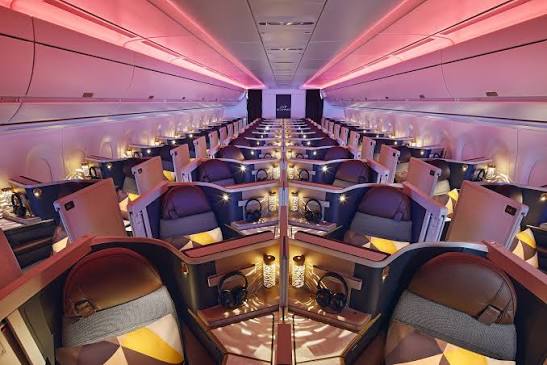
The A321LR introduced lie-flat Business Class seating despite being a narrow-body aircraft.
Premium passengers can generate substantially more revenue than Economy customers.
Abu Dhabi’s growing role in finance, investment and luxury tourism supports this market.
The airline therefore does not compete purely on passenger volume.
Yield matters as much as seats filled.
Economy Passengers Still Provide the Scale
Premium cabins receive attention, but most passengers travel in Economy.
A successful global airline needs to serve both groups effectively.
Etihad has continued investing in entertainment, digital platforms and service across the entire aircraft.
Customer satisfaction improved strongly during 2025.
This is important because modern airline comparison is immediate.
Travellers can compare fares and reviews across numerous competitors within minutes.
The New Abu Dhabi Airport Terminal Changed the Hub Experience
Etihad’s move into the modern terminal at Zayed International Airport gave the airline infrastructure more suited to growth.
A hub airline needs fast connections.
Passengers should be able to move between gates efficiently.
Premium lounges need sufficient capacity.
Baggage systems must handle growing volumes.
Airport infrastructure can therefore constrain or enable an airline.
Abu Dhabi now has significantly more room to support Etihad’s expansion.
The Airline Added More Than 3,200 Employees in 2025
Growth requires people as well as aircraft.
More than 3,200 employees joined Etihad during 2025.
The workforce represented over 150 nationalities.
Aviation is labour-intensive.
Pilots, cabin crew, engineers, operations specialists and airport staff all need extensive training.
Hiring quickly while maintaining safety standards is difficult.
Human-capital development therefore becomes one of the main constraints on expansion.
Training Pilots Takes Years
Aircraft can sometimes be leased relatively quickly.
Pilots cannot.
They require extensive education, simulator training and aircraft-specific qualifications.
Captain development takes even longer.
This means airlines must plan workforce growth years ahead.
Etihad’s expansion therefore requires continued recruitment as well as investment in Emirati cadet pilots and internal career development.
An AA- Credit Rating Is Significant
Fitch upgraded Etihad to AA- in late 2025.
This matters because aircraft and aviation infrastructure are expensive.
A stronger credit profile can reduce financing costs.
It also signals confidence in the company’s balance sheet and operating model.
Airlines historically have not always been viewed as strong credit risks because the industry is volatile.
A high rating therefore provides Etihad with a valuable advantage as it finances expansion.
Cash Flow Can Now Fund Investment
Etihad generated almost AED 8 billion in operating cash flow during 2025.
The airline stated that this was sufficient to finance its annual capital expenditure while also reducing leverage.
This is one of the strongest indicators that the turnaround has worked.
A growth strategy is much more sustainable when the business itself generates the money required to support it.
Geopolitics Remains an Unavoidable Risk
Etihad operates from a region that can experience sudden airspace disruption.
Routes may need to be changed.
Flights can be cancelled.
Longer paths consume more fuel.
Demand can weaken temporarily.
No management team can eliminate this risk.
The best defence is financial strength, network diversification and operational flexibility.
The airline’s improved cash generation provides greater resilience than it possessed during earlier periods.
Fuel Remains Another Major Variable
Like every airline, Etihad is exposed to energy prices.
Fuel is one of aviation’s largest operating expenses.
Newer aircraft improve consumption.
Efficient route planning helps.
But global oil prices remain outside the airline’s control.
This makes cost discipline elsewhere particularly important.
A financially efficient airline has more room to absorb fuel-price volatility.
Sustainability Is a Long-Term Challenge
Aviation remains difficult to decarbonise.
Etihad has participated in sustainable aviation fuel initiatives and invested in newer aircraft.
The A350 and Boeing 787 provide better fuel efficiency than older-generation wide-bodies.
The A321LR can match aircraft capacity more closely to demand on thinner routes.
These changes reduce emissions intensity.
But eliminating aviation emissions entirely will require much larger technological breakthroughs.
Etihad’s Growth Is Really an Abu Dhabi Growth Strategy
The airline’s importance goes beyond its own profits.
Etihad brings tourists.
It supports the airport.
It enables cargo.
It connects Abu Dhabi businesses to international markets.
It makes the Emirate easier for multinational companies to access.
It supports events, hotels and cultural attractions.
This is why airline growth has such significant economic spillovers.
Connectivity is part of the infrastructure required for a global city.
Why Etihad Airways Matters
Etihad Airways has already experienced two very different eras.
The first prioritised rapid global expansion and complex international investments.
The second required restructuring and discipline.
The company is now entering a third phase.
Growth has returned, but this time it is being built on record profitability and stronger cash generation.
In 2025, Etihad carried 22.4 million passengers, expanded to 110 destinations and grew its operating fleet to 127 aircraft.
Revenue reached AED 30.7 billion.
Profit after tax reached a record AED 2.6 billion.
Those results matter.
But the more important test lies ahead.
Etihad is trying to prove that an airline can learn from an earlier expansion cycle and grow aggressively without repeating its mistakes.
If Journey 2030 succeeds, the turnaround will not simply have saved an airline.
It will have created one of the central engines of Abu Dhabi’s next phase of global growth.
Contributed by GuestPosts.biz.