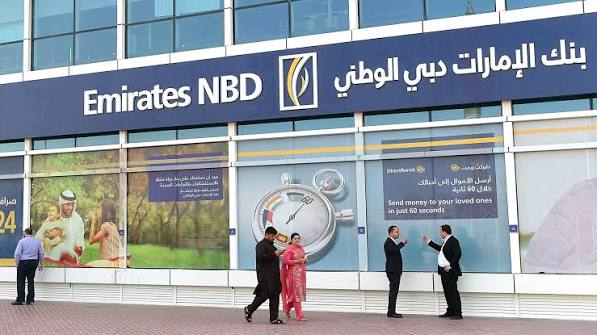
Few companies reflect Dubai’s transformation as clearly as Emirates NBD.
Its origins date back to 1963, when National Bank of Dubai was established as the first national bank in the UAE.
Dubai itself was very different at the time.
The modern skyline did not exist.
The city’s role as an international business and tourism centre was still decades away.
More than sixty years later, the banking group that grew from those beginnings has become one of the largest financial institutions in the Middle East.
Emirates NBD now serves millions of customers across a network stretching far beyond the UAE.
Its story closely follows the development of Dubai from regional trading centre into global financial hub.
The 2007 Merger Created Today’s Emirates NBD
The modern bank was formed through the merger of National Bank of Dubai and Emirates Bank International in 2007.
The deal combined two important Dubai financial institutions into a single larger group.
The logic was similar to other major Gulf banking consolidations.
Scale creates greater lending capacity.
It allows larger investments in technology.
It helps a bank expand internationally.
It also creates a broader deposit and customer base.
The resulting Emirates NBD became one of Dubai’s most strategically important companies.
Its Balance Sheet Has Passed AED 1.3 Trillion
By the end of June 2026, Emirates NBD reported total assets of approximately AED 1.32 trillion.
Gross loans stood at AED 771 billion.
Deposits reached AED 892 billion.
These figures demonstrate the scale of the organisation.
A bank of this size can finance major corporations, infrastructure projects, governments and households simultaneously.
It can also invest heavily in digital banking while expanding into new international markets.
Scale does not guarantee success, but it creates strategic options smaller institutions simply do not have.
Dubai’s Growth Created a Powerful Domestic Franchise
Emirates NBD benefited enormously from Dubai’s expansion.
Every new business creates financial activity.
Companies need accounts and working capital.
Residents need mortgages, cards and personal banking.
Property development creates demand for construction finance and home lending.
Tourism produces payments and foreign-exchange transactions.
International trade requires letters of credit and cash-management services.
As Dubai expanded, the banking opportunity expanded with it.
Emirates NBD became one of the institutions supporting this activity.
Retail Banking Reaches Millions of Customers
Consumer banking remains a major part of the group.
Customers use Emirates NBD for everything from salary accounts and mortgages to cards and investment products.
The scale creates a large ecosystem.
Someone may begin with a basic account after moving to Dubai.
Later, the same customer may need a car loan, mortgage, savings product or investment service.
Banks benefit when they can remain part of a customer’s financial life over many years.
Digital technology makes this relationship increasingly important.
Digital Banking Changed Customer Expectations
Banking has moved rapidly away from the branch.
Customers now expect to transfer money, manage cards, apply for products and communicate with their bank through mobile platforms.
Emirates NBD has invested heavily in this area.
Its digital strategy includes its mainstream banking applications as well as Liv, a digital banking proposition developed initially with younger customers in mind.
The lesson is clear.
A large physical banking network is no longer enough.
The digital experience increasingly determines how customers judge their bank.
Artificial Intelligence Is Becoming Part of the Strategy
The bank is also increasing its use of artificial intelligence.
AI can improve customer support, detect fraud, analyse credit risk and help employees process information more effectively.
Generative AI creates additional opportunities.
Employees may use intelligent tools to analyse documents, prepare information or respond more rapidly to customer enquiries.
For a bank with millions of customers, automation can significantly improve efficiency.
However, financial AI also needs strong controls.
Banking data is highly sensitive, and automated decisions can have real consequences for customers.
Corporate Banking Connects the Bank to the Wider Economy
Emirates NBD’s role goes far beyond individual customers.
The bank provides financing and financial services to businesses ranging from small companies to major regional corporations.
Corporate lending supports expansion, acquisitions and everyday working capital.
Trade-finance operations help companies import and export goods.
Cash-management services help large businesses control payments across complex organisations.
This activity links the bank directly to economic growth.
When UAE companies expand, their banks often grow alongside them.
Islamic Finance Has Become a Major Pillar
The Emirates NBD Group also has a significant Islamic finance business through Emirates Islamic and the group’s Islamic banking activities.
By mid-2026, combined Islamic assets exceeded AED 250 billion.
This is important because the UAE has ambitions to become one of the world’s leading centres for Islamic finance.
Sharia-compliant banking is not simply a domestic niche.
It represents a major global financial sector spanning consumers, corporations, investment products and capital markets.
Emirates NBD therefore participates in both conventional and Islamic finance at substantial scale.
International Expansion Has Accelerated
The group now operates across numerous international markets.
Its presence includes Türkiye, Egypt, Saudi Arabia, India, Singapore, the United Kingdom and other countries.
This network gives Emirates NBD exposure to some of the world’s most important trade corridors.
Dubai sits geographically between Asia, Africa and Europe.
Many companies based in the Emirate conduct business across these regions.
An international banking network can support these clients more effectively.
DenizBank Transformed the International Business
One of Emirates NBD’s most significant international moves was its acquisition of DenizBank in Türkiye.
The transaction gave the group a large banking platform in one of the region’s biggest economies.
DenizBank brought hundreds of branches and millions of customers into the group.
International acquisitions can be challenging.
They expose banks to different regulations, currencies and economic cycles.
However, they can also transform scale quickly.
DenizBank gave Emirates NBD a much larger footprint outside its home market.
India Is Becoming Another Major Growth Market
The group’s international ambitions expanded again through RBL Bank.
Emirates NBD completed a major investment in the Indian bank in 2026.
India is strategically important for several reasons.
It is one of the world’s largest and fastest-growing economies.
It also has deep commercial and demographic connections with the Gulf.
Millions of Indians live and work in the UAE.
Trade and investment flows between the two countries continue growing.
A stronger Indian banking presence therefore connects naturally with Emirates NBD’s home market.
The RBL Bank Deal Changed the Group’s Scale
Following the RBL Bank transaction, Emirates NBD’s balance sheet surpassed AED 1.3 trillion.
RBL added tens of billions of dirhams in assets, loans and deposits to the group.
More importantly, it provided access to a much larger customer base and another significant banking market.
The transaction illustrates Emirates NBD’s broader strategy.
International expansion is no longer based only on opening individual overseas branches.
Acquisitions can establish a substantial local position much faster.
Profitability Has Remained Strong During Expansion
Emirates NBD generated AED 16.2 billion in profit before tax during the first half of 2026.
Total income reached AED 27.9 billion.
This performance was supported by growth in both traditional interest income and non-funded income.
Diversified earnings are particularly important for banks when interest rates change.
Fee income, investment products, cards and other financial services can help reduce dependence on lending margins.
Deposits Are a Major Competitive Strength
Customer deposits reached AED 892 billion by mid-2026.
A large and stable deposit base provides relatively dependable funding.
This supports lending and helps reduce reliance on more expensive sources of finance.
Current and savings accounts are especially valuable because they often carry lower funding costs.
For a bank, the customer relationship therefore has value far beyond the individual product being used.
A salary account may ultimately support lending elsewhere in the institution.
Payments Are Becoming a Technology Business
Banks face growing competition from fintech companies.
Payments that once occurred almost entirely through bank cards can now pass through digital wallets, payment apps and specialised fintech platforms.
Emirates NBD therefore competes not only with traditional banks but also with technology companies.
This is forcing financial institutions to innovate more quickly.
Customers expect instant transfers, simple interfaces and seamless digital authentication.
The old assumption that people will tolerate complicated banking processes is disappearing.
Wealth Management Is Another Major Opportunity
Dubai’s growing population of wealthy residents creates a substantial private-banking opportunity.
Entrepreneurs and investors increasingly relocate to the UAE.
Family offices are expanding.
International professionals are building wealth while living in the Emirates.
These clients need investment management, international banking, lending and succession-planning services.
A large regional bank with international operations is well positioned to serve them.
This could become an increasingly important part of Emirates NBD’s future growth.
The Bank Is Closely Connected to Dubai’s Development
Emirates NBD remains strongly associated with Dubai.
The Government of Dubai retains a significant ownership interest through its investment entities.
That relationship gives the bank a strategic role in the Emirate’s economy.
At the same time, Emirates NBD has evolved far beyond a local government-linked institution.
Its international acquisitions, digital banking and capital-market activities now make it a regional financial group.
Why Emirates NBD Matters
Emirates NBD began with the creation of Dubai’s first national bank in 1963.
Six decades later, the group has more than AED 1.3 trillion in assets and serves customers across multiple international markets.
Its expansion mirrors Dubai’s own transformation.
Both began with strong local roots.
Both used trade and international connectivity as growth engines.
And both gradually expanded their influence far beyond the UAE.
Today, Emirates NBD is not simply a bank serving Dubai.
It is one of the institutions helping connect Dubai to the wider financial world.
Contributed by GuestPosts.biz.