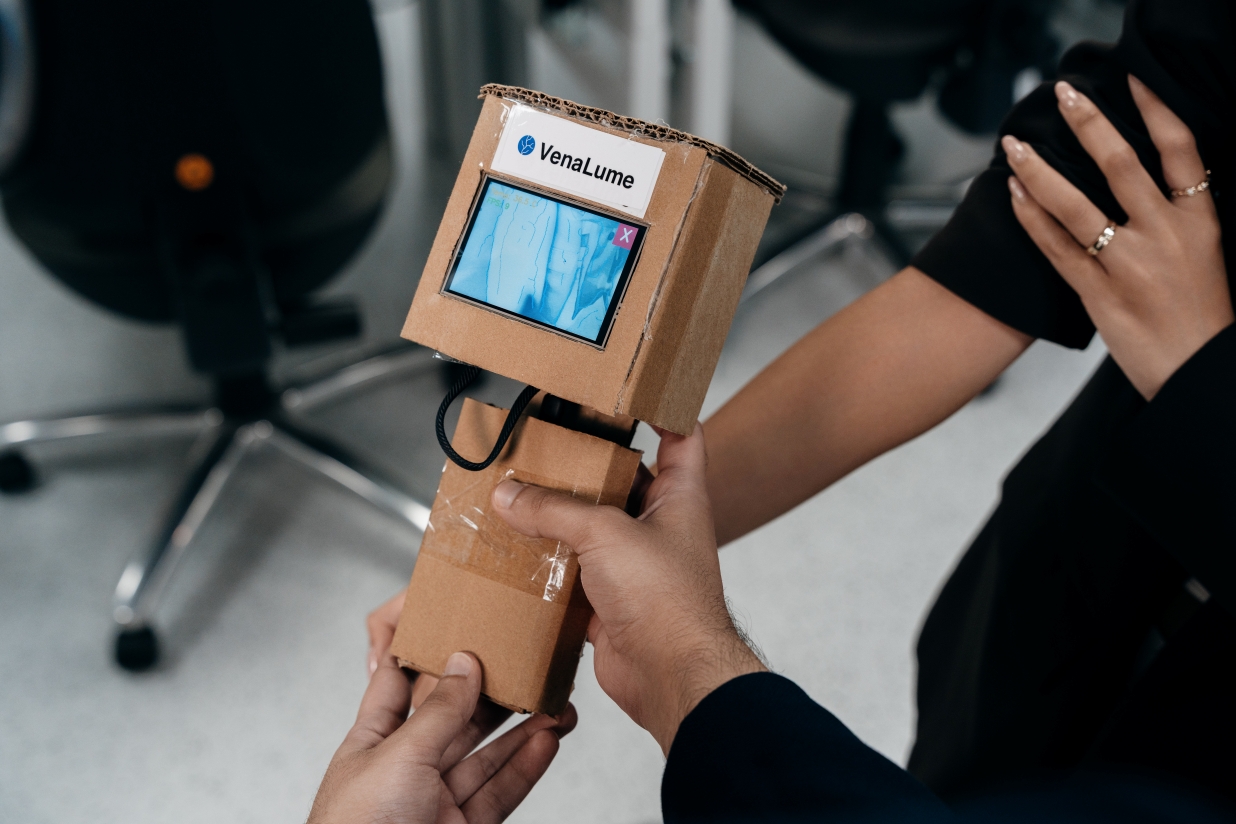
Two inventions from UAE students have been selected among the global Top 20 finalists for the 2026 James Dyson Award, placing local young innovators on the international stage for their solutions to challenges in healthcare and accessibility.
Selected by a panel of Dyson engineers from this year’s national winners and runners-up, the global Top 20 recognises inventions that demonstrate strong problem-solving and engineering potential. The UAE’s two shortlisted projects, VenaLume and VocaBuddy, both draw on personal experiences to address challenges that affect patients, individuals and families, with each now progressing to the final stage of the international competition.
VenaLume
The National winner of the UAE award, developed by Middlesex University Dubai student Umer Farhan, VenaLume is designed to support intravenous catheter insertions by helping healthcare professionals identify difficult venous access and visualise veins in real time.
The system combines an AI-based assessment to identify patients who may have difficult venous access with near-infrared imaging that makes veins beneath the skin easier to see. The project has already been recognised at several UAE innovation competitions, with the next stage focused on clinical testing and further development.
Umer Farhan, inventor of VenaLume, said: “Being selected for the James Dyson Award Global Top 20 is a major milestone for VenaLume. What started as an idea inspired by my own experiences has grown into a solution with the potential to make a real difference for both patients and healthcare professionals. This recognition gives me further motivation to continue developing VenaLume and bring it closer to real-world clinical use.”
VocaBuddy
VocaBuddy, developed by Curtin University Dubai student Erdzean Nathaniel Sybico, is a wearable communication device designed to help non-verbal children express everyday needs using familiar images, voices and tactile buttons.
Inspired by Erdzean non-verbal autistic cousin, the device was developed with input from therapists, specialists and families. The next stage will focus on further testing before progressing towards pilots in autism centres.
Erdzean Nathaniel Sybico, inventor of VocaBuddy, said: “VocaBuddy started from seeing the communication challenges faced by someone very close to me and wanting to create something that could make everyday communication feel more personal and intuitive. Being selected for the Global Top 20 gives me the opportunity to continue developing the idea and hopefully support more children and families in the future, with the hope of helping more non-verbal children communicate their needs and giving their families greater confidence and understanding..”
Kay Yeong, Principal Engineer and James Dyson Award Top 20 Judge said: “The James Dyson Awards always attracts entries from a broad spectrum of areas, and this year no less so! This keeps things interesting, but it can be difficult to choose between say a children’s health device and a geoengineering structure. My favourite entries are those that surface problems that I didn’t know needed solving and this is something that a lot of the top 20 have in common. It is precisely these kinds of thought-provoking insights that are needed to help us invent practical, everyday solutions to improve lives. I’m excited to see who takes home the global prize.”
The Top 20 Shortlist
| Project |
Solution: |
Inventor: |
Country / Region |
| VenaLume | A vein visualiser for Intravenous Catheter insertions | Umer Farhan | UAE |
| VocaBuddy | A wearable communication device for non-verbal children. | Erdzean Nathaniel Sybico | UAE |
| AnemoSwab | A non-invasive breath test for respiratory diseases | Yonatan Morocz | Canada |
| BiDaKidney | A low-cost, semi-automated dialysis machine | Andrew Jacob Buensalido,
Allyson Cabrestante |
Philippines |
| BiliRoo | A phototherapy sling for treating newborn jaundice | Daniel John | US |
| Bobo | A handheld menstrual health companion | Anoushka Sawardekar | UK |
| CaneSight | An AI-powered navigation aid for blind people | Bing He Sun | Mainland China |
| Egle | An assistive mask for blind football | Gildas Bouger | France |
| Fixwing | A self-securing IV catheter | Shin Ding Min, Joo Songmin | Korea |
| mömigo | A reusable, all-in-one breastmilk system | Nicolette Wong | Singapore |
| morito | A fire-free prayer tool | Masano Yu, Suda Takeharu, Yamada Hayato, Hirose Kazuki | Japan |
| Noli | A discreet emergency wristband for mental health nurses | Ella Flanagan | Ireland |
| NURA | A sign language translating wristband | Samuel Nagel,
Paul Feiler |
Germany |
| Reefvive | A recycled coral reef restoration base | Yin-Rui Liao | Taiwan |
| RUDHRA | A voice-controlled Braille printer | Lingampalli Himaja | India |
| Rumble Rims | A sideline concussion screening device | Radhika Saran, Cleo Pontone, Sophia DeVito | US |
| Saturn | A head-operated wheelchair controller | Seán-Jameson Galvin, Jamie Luik, Miha Arink, Lieke Neppelenbroek, Jens Peeters | Netherlands |
| Sentinel | An embedded earthquake damage sensor | Aldrei Ong | Philippines |
| Softact | A robotic breast screening system | Peng Yang, Yujie Zang, Zhiyu Xu Jianzi Ma Baohong Li | Mainland China |
| SoleTrace | An early Parkinson’s screening tool | Hyunjae Noh | Canada |
James Dyson Award
The James Dyson Award is an international design competition which inspires and celebrates the next generation of design engineers. Now in its 21st year, the Award has supported more than 400 problem-solving inventions with over £1.5m in prize money. It operates across 28 countries and regions and is run by the James Dyson Foundation, Sir James Dyson’s engineering-education charity.
James Dyson Foundation
The James Dyson Foundation, established in the UK in 2002, now supports design, technology and engineering education programmes not only in the UK but also in countries around the world, including the United States, Japan, Singapore, the Philippines and Malaysia. To date, James Dyson and the James Dyson Foundation have donated more than £155 million to charitable causes. This includes a £12 million donation to establish the Dyson School of Design Engineering at Imperial College London, an £8 million donation to support the creation of the Dyson Centre for Engineering Design and the James Dyson Building at the University of Cambridge and finally, a £7.8 million donation to fund Malmesbury Primary School’s STEAM Centre and expansion project.